 Skill
 Muse
 Dot
 Cue
 Hermes
 Premium
Email Triage Automation
- Read full threads
- Sort into 3 buckets
- Draft in your voice
- Approve & send
← All skills · Automation · Research Brief Compiler
Premium Premium
 Free
 Premium
An example of what this Skill produces. Sample content, shown for illustration.
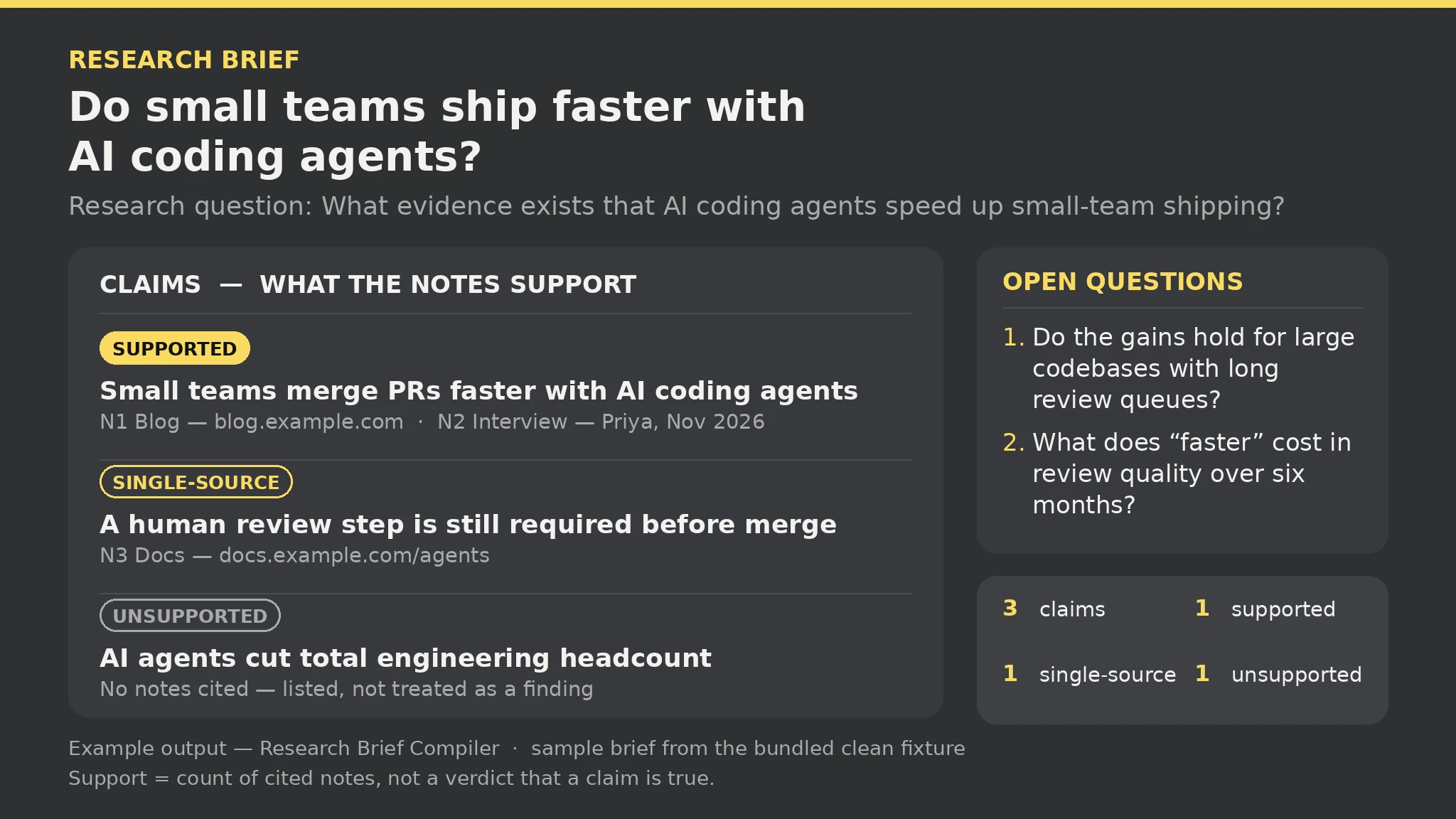
Research Brief Compiler report — sample

Claims: 3 | Supported: 1 | Single-source: 1 | Unsupported: 1 | Open questions: 2 | Notes: 4 | Gaps: 1 | Errors: 0 | Warnings: 0

Supported: small teams merge PRs faster with AI coding agents — N1 (Blog — blog.example.com/ai-agents-shipping) and N2 (Interview — Priya, Nov 2026). Single-source: a human review step is still required before merge — N3 (Docs — docs.example.com/agents). Unsupported: AI agents cut total engineering headcount — no notes cited, listed not treated as a finding. Open: do the gains hold for large codebases, and what does “faster” cost in review quality?

Gaps: 1 claim cites no notes.
Turn these collected notes into a research brief — what do the notes actually support, what rests on a single source, and what is still open?Read https://skillu.dev/install/agent.md, then install the Research Brief Compiler skill (research-brief-compiler)./research-brief-compiler, and describe what you want in plain words.From the notes you cite, nothing else: supported means 2 or more distinct notes, single-source means exactly 1, unsupported means none. Two notes saying the same thing make a claim supported in this brief; they do not make it correct — the notes themselves could be wrong, outdated, or from the same original source, and that judgement is yours.
It is dropped and named in the input errors — the script never invents a source to back a claim. Add the missing Note line with its source pointer and re-run, and the claim will be graded from the notes you actually collected.